
Deceiving the Deceiver
The Shawshank Redemption as an Allegory for Christ’s Deception of the Devil (1)

On the outside I was an honest man, straight as an arrow. I had to come to prison to be a crook. -Andy Dufrense, The Shawshank Redemption
With cunning words [Satan] deceived Adam, and now with divine words the cunning one himself shall be deceived. -St. John Chrysostom2
This article contains spoilers for the film The Shawshank Redemption.
Frank Darabont’s movie The Shawshank Redemption deals with a fundamental question of human existence: how is it possible to tell the truth in an environment based on lies and deception? In a world where appearances mask reality and seeming truths serve as a veil for falsehood, how can the true nature of reality be discerned? This is the situation Andy Dufrense finds himself in when he is falsely charged with the murder of his wife and the man she is having an affair with. Having been falsely convicted and now surrounded by guilty men who insist that they are innocent in Shawshank prison, Andy’s claim to true innocence is drowned out in a sea of lies. How can the truth of Andy’s innocence be established in a world of deception?
The answer, of course, is by deception itself. When the world is upside down, the only way to make the world right-side up is by turning it upside down once more. In the same way, Andy utilizes the system of lies and deception in the prison in order to establish more humane living conditions for his fellow prisoners and, in due time, to establish his own freedom and innocence. In order to triumph over the deceiving figure of the warden and his system of lies, Andy himself must become a deceiver.
Similarly, the Fathers of the Church expressed the view that Christ, the eternal Son of God, saved the world through deception. By entering into the fallen human world in “the likeness of sinful flesh,”3 Christ was actively concealing his true divine identity from the devil, luring Satan to put Christ to death as a mere mortal. It was this act of deception by Christ that resulted in the devil conspiring with the human authorities of the Pharisees, the Sanhedrin, and the Roman Empire to crucify Jesus. Yet this act of crucifixion of an innocent man was precisely what undid the devil’s power, for by his death the Son of God entered into death and destroyed it. The devil’s deception of humanity at the fall was undone by Christ’s deception of the devil. Through a tree humanity was deceived and died, and through a tree the devil was deceived and humanity lives.4
These parallels between Christ’s deception of Satan and Andy Dufrense’s deception of the warden can be seen early on in The Shawshank Redemption. Andy’s first encounter with the warden has numerous parallels with Satan’s temptation of Christ in the Gospels. Notably, both happen after a miraculous event: for Christ, after his baptism when the Holy Spirit descended upon him in the form of a dove, and for Andy, after he made an unheard-of agreement with the prison guards to give them tax advice in exchange for cold beer for him and his fellow prisoners. In the Gospel of John, however, Christ’s first public miracle is not his baptism, but rather his multiplying of wine at the wedding of Cana, a clear parallel with Andy’s miraculous appearance of alcohol. In both Christ’s and Andy’s case, their opponent does not understand who they are: Satan fails to perceive Christ’s divinity, while the warden fails to perceive Andy’s innocence.5 Both encounters center around quotations from Scripture. Satan and Christ have this exchange:
Then the devil took him to the holy city, and set him on the pinnacle of the temple, and said to him, “If you are the Son of God, throw yourself down; for it is written,
‘He will give his angels charge of you,’
and
‘On their hands they will bear you up, lest you strike your foot against a stone.’ ”
Jesus said to him, “Again it is written, ‘You shall not tempt the Lord your God.’”6
There is a palpable irony at play in this passage. When Christ, quoting the Scriptures, says “You shall not tempt the Lord your God,” the devil believes that Christ is saying something to the effect of, “Since I am a man, I should not tempt God by throwing myself from the temple and expecting him to save me.” However, in reality, Christ’s words are actually a warning to the devil and a confession of his own divinity, meaning something like: “I am God, and you, the devil, are daring to tempt me.” A very similar encounter happens between Andy and the warden, with the warden in the place of the devil and Andy in the place of Christ:
Warden: I’m pleased to see you reading this [the Bible]. Any favorite passages?
Andy: “Watch ye therefore, for ye know not when the master of the house cometh.”
Warden: Mark 13:35. I’ve always liked that one. But I prefer: “I am the light of the world. He that followeth me shall not walk in darkness, but shall have the light of life.”
Again, a similar reversal of meaning is present here. The warden believes Andy to be saying, “Since I am a prisoner, I need to watch for when you, the master of the house, are coming.” But in reality, Andy is giving a warning to the warden, saying, “I am the master of the house, and you need to watch for when I am coming.”
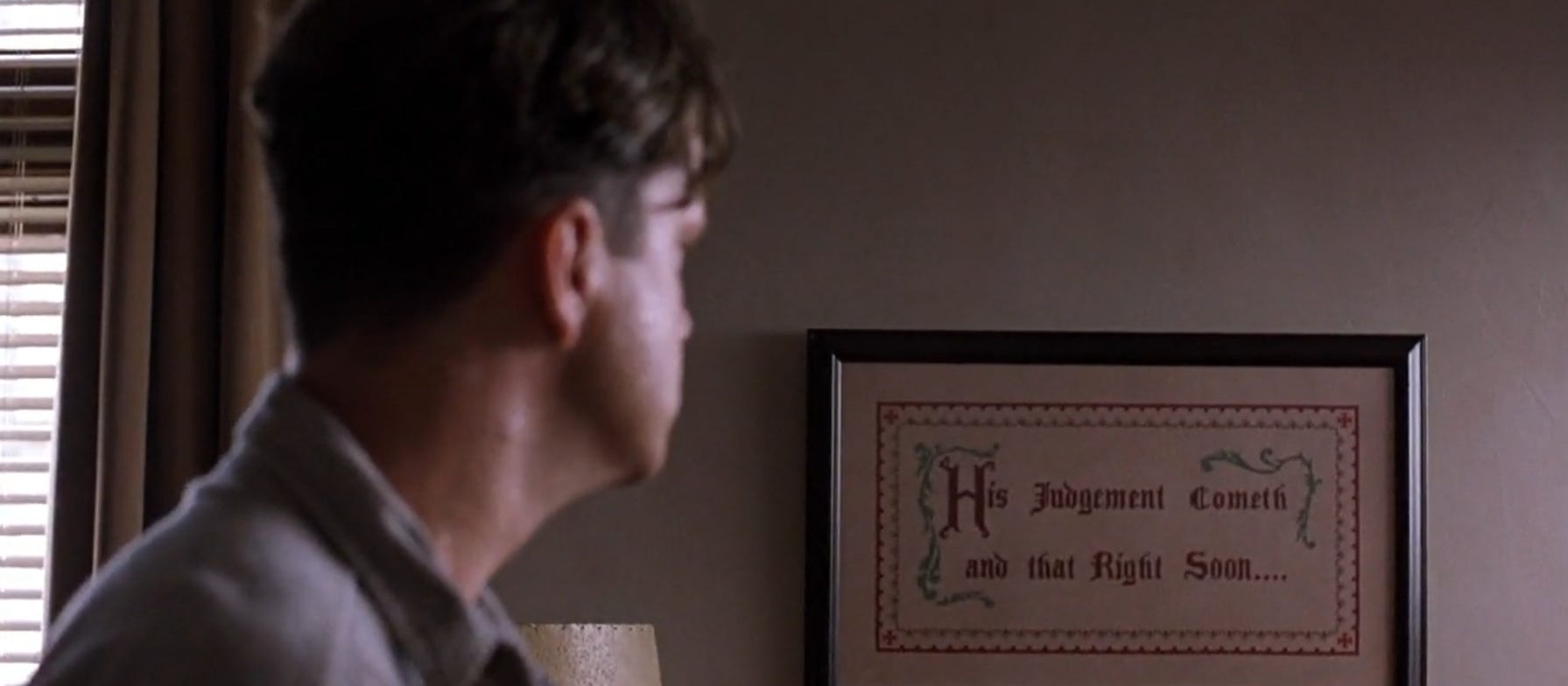
Another instance where Scripture appears in the film is the warden’s framed sign with the quote, “His judgement cometh, and that right soon,” from the Wisdom of Sirach.7 Presumably, the warden intends the quote from Scripture to warn prisoners regarding his position as an administrator of justice; the warden is the judge, and his judgement will come soon upon the prisoners. Andy, however, reveals the quote to have the opposite meaning; Andy is the judge, and his judgement is coming soon upon the warden. The framed quote from Scripture also covers a safe where the warden hides records of his criminal activity; the warden is literally hiding his sins behind the veil of the scriptural text, much like the devil quoting Scripture in order to tempt Christ. A reversal of this comes towards the end of the film when the warden finds out that Andy has replaced his criminal financial records hidden in the safe with Andy’s copy of the Bible. When the warden opens the Bible, he finds that it had previously contained the rock hammer that Andy had used to tunnel his way out of Shawshank. Notably, the rock hammer was hidden at the book of Exodus, which tells the narrative of God’s liberation of the Israelites from slavery in Egypt. Contrary to using the scriptural text to cover and conceal his sins like the warden, Andy has instead used Scripture to reveal the truth about reality: Andy is innocent and being liberated from slavery like the Israelites, and the warden, like Pharoah of old, is an enslaving tyrant deserving of God’s judgement.
The judgement of God comes upon the warden soon, with the warden committing suicide as the police come to arrest him for his crimes. The warden takes his own life in order to avoid facing his betrayal of Andy that led to his own downfall, much like Judas took his own life to avoid facing his betrayal of Christ.8
After Andy escapes from Shawshank, he spends his days on the beach working the wood of a fishing boat where he later meets his friend Red, the only prisoner in Shawshank brave enough to admit that he was actually guilty. Just as Christ met his disciples after the resurrection while they were fishing, so too does Andy meet Red while fishing, inviting him into a world where the deception of Shawshank has passed away.
1: This piece would not have been possible without the insights of Matthew Miller of the YouTube channel Logos Made Flesh. May his memory be eternal and may God grant him rest in the kingdom of heaven. See “The Hidden Meaning of the Shawshank Redemption” and “Shawshank’s Hallowed-Out Bible.”
2: Quoted in the article of Fr. Maximos Constas, “The Last Temptation of Satan: Divine Deception in Greek Patristic Interpretations of the Passion Narrative.” The Harvard Theological Review, Vol. 97, No. 2.
3: Romans 8:3.
4: For more about the Church Fathers’ view that Christ deceived the devil, see Fr. Maximos Constas, “The Last Temptation of Satan.”
5: Contrary to popular tellings of Christ’s life, Satan did not understand that Christ was divine and thus did not understand that crucifying Christ was the very means by which God would undo Satan’s dominion of death. This is said by the Apostle Paul in 1 Corinthians 2:7-8: “But we impart the hidden wisdom of God in a mystery, which God predestined before the ages for our glory, which none of the rulers of this age understood, for if they understood, they would have never crucified the Lord of glory.” Contextually, the phrase “rulers of this age” (literally “archons of this age”) is a reference to the demonic powers that conspired with human powers to crucify Christ; these demonic powers include Satan himself. For other scriptural references, see also 1 Peter 1:10-12. The hymnographic tradition of the Orthodox Church likewise insists that none of the angelic beings understood Christ’s incarnation: “That which was hidden from eternity even to the angels, a mystery unknown, through you, Theotokos, is revealed to those on earth: God incarnate by union without confusion, Who even voluntarily accepted the Cross for us…” Mode 4 Theotokion translation quoted from the Patriarchate of Antioch webpage, “Jesus Declares Himself Pre-eternal”: < https://www.antiochpatriarchate.org/en/page/2321/ >.
6: Matthew 4:5-7.
7: Wisdom of Sirach 21:5.
8: Matthew 27:5.